
Why the Boring Basics are the Best - By Ben Howie (Physiotherapist)
If you’ve been to an exercise class at Thrive before, you’ve probably heard someone ask, “Didn’t we do this exercise last week?”
Yes, we did. And we’ll probably do it next week too.
I get it. Social media is full of new exercises, with funky equipment and crazy positions. Most of them make squats, deadlifts, pushes and pulls look dull. But the people that get stronger aren’t the ones who constantly chase the newest exercise. They’re the ones who keep turning up and doing the basics.
Why we keep coming back to the basics
These are the movements you use every day. You squat to get out of a chair or the car, hinge to pick up the shopping or the kids, push a door or a pram, and pull a bag of shopping onto the kitchen counter.
They’re also compound movements, meaning they move several joints at once and therefore recruit more muscles than single-joint exercises like a bicep curl.
Australia’s physical activity guidelines recommend strength training on at least two days a week (Department of Health, Disability and Ageing 2026), and a handful of basic lifts covers that nicely, as shown in the table below.
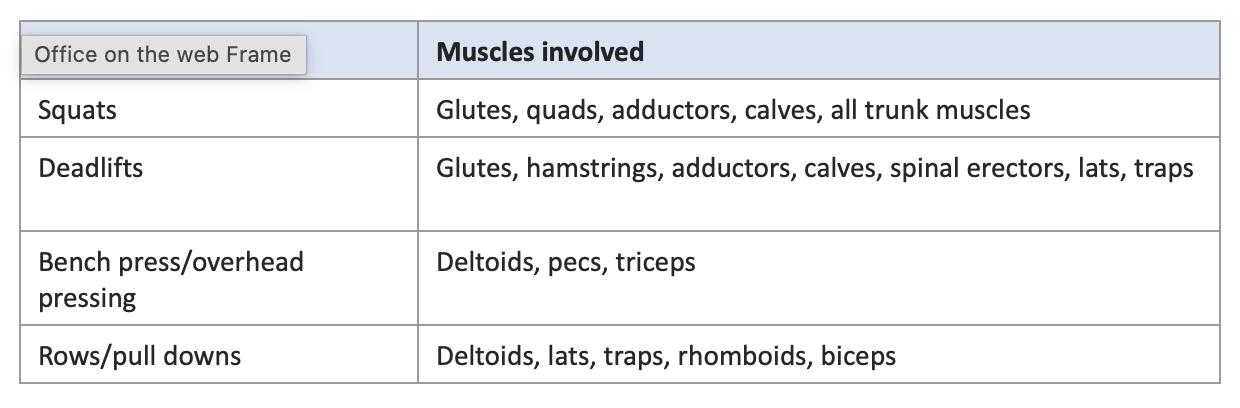
Obviously, there are plenty of other exercises and slightly different variations people can use if they need to prioritize certain areas due to injury or personal goals. But generally speaking, every program should be built around these basics. Think of them as the foundations or walls of your house. They hold a strong base and structure for everything else to be built upon.
Why consistency is important?
Your body adapts to repeated load over time, not one big effort every couple of weeks, and different tissues adapt at different speeds.
In the first few weeks, most strength gains come from your nervous system getting better at switching muscles on (Škarabot et al. 2021). That’s why a new exercise often feels easier surprisingly quickly. Muscle growth takes longer and depends on regular, progressive training (Currier et al. 2026). Tendons are slower, with programs longer than 12 weeks producing bigger improvements in tendon stiffness (Bohm et al. 2015).
The catch is that these gains fade when you stop (Encarnação et al. 2022). One big session followed by two weeks off doesn’t give your body much to work with. Two or three sessions a week, kept up for months, does.
Doing the same exercises is how you measure progress
If your workout changed every week, you’d have nothing to compare it to. Stick with the same lifts and progress becomes easy to see. Such as squatting 40 kg for eight reps in week one and 50 kg by week eight, going from 5 push-ups to 10, or moving from assisted rows to chin-ups. Sometimes it’s moving better at the same weight, or a session that used to leave you sore now feeling fine.
Not every good day is real progress, though. Clinicians use the minimal clinically important difference, the smallest change that actually matters to a person, to judge whether an improvement is real (Salas Apaza et al. 2021). Repeating the same lifts makes the overall trend much easier to spot.
How to progress
Boring doesn’t mean doing the same thing forever. Once a lift feels comfortable for your target reps, make it a little harder. This is called progressive overload (Currier et al. 2026; Plotkin et al. 2022). Add a bit of weight, an extra rep or set, slow down the lowering phase, or try a single-leg or single-arm version. I’d change one thing at a time, so if something doesn’t feel right, you know why.
Making it stick
My biggest tip is to book your sessions into your week like any other appointment. A recent review found new health habits took an average of about two months (59 to 66 days) to form, but anywhere from 4 to 335 days; depending on the person. It also showed that doing the exercises often and at a consistent time helped (Singh et al. 2024). So if you miss a session, don’t stress. Just turn up to the next one.
Write down your weights and reps, too. Looking back and seeing how far you’ve come is hugely motivating. And keep it simple: four or five basic lifts in 30 to 45 minutes is plenty for most people. If you’re unsure about your technique, a physio can help you set up each lift properly.
The bottom line
The basics work. Do them at least twice a week, track your numbers, and add a little more when things feel easy. Stick with it for a few months and you’ll be surprised how far you’ve come.
Not sure where to start, or working around pain or an old injury? Come and see one of our team at Total Physiotherapy. We’ll check your technique, find a starting point that suits you and help you build a routine you’ll actually stick with.
References
Bohm S, Mersmann F and Arampatzis A (2015) ‘Human tendon adaptation in response to mechanical loading: a systematic review and meta-analysis of exercise intervention studies on healthy adults’, Sports Medicine – Open, 1(1):7, https://doi.org/10.1186/s40798-015-0009-9.
Currier BS, D’Souza AC, Fiatarone Singh MA, Lowisz CV, Rawson ES, Schoenfeld BJ et al. (2026) ‘American College of Sports Medicine position stand: resistance training prescription for muscle function, hypertrophy, and physical performance in healthy adults: an overview of reviews’, Medicine & Science in Sports & Exercise, 58(4):851–872, https://doi.org/10.1249/MSS.0000000000003897.
Department of Health, Disability and Ageing (2026) Australian 24-hour movement guidelines for adults (18–64 years) and older adults (65+ years), Australian Government, accessed 31 October 2026, https://www.health.gov.au/topics/physical-activity/24-hour-movement-guidelines-for-all-australians.
Encarnação IGA, Viana RB, Soares SRS, Freitas EDS et al. (2022) ‘Effects of detraining on muscle strength and hypertrophy induced by resistance training: a systematic review’, Muscles, 1(1):1–15, https://doi.org/10.3390/muscles1010001.
Plotkin D, Coleman M, Van Every D, Maldonado J, Oberlin D, Israetel M, Feather J, Alto A, Vigotsky AD and Schoenfeld BJ (2022) ‘Progressive overload without progressing load? The effects of load or repetition progression on muscular adaptations’, PeerJ, 10:e14142, https://doi.org/10.7717/peerj.14142.
Salas Apaza JA, Franco JVA, Meza N, Madrid E, Loézar C and Garegnani L (2021) ‘Minimal clinically important difference: the basics’, Medwave, 21(3):e8149, https://doi.org/10.5867/medwave.2021.03.8149.
Singh B, Murphy A, Maher C and Smith AE (2024) ‘Time to form a habit: a systematic review and meta-analysis of health behaviour habit formation and its determinants’, Healthcare, 12(23):2488, https://doi.org/10.3390/healthcare12232488.
Škarabot J, Brownstein CG, Casolo A, Del Vecchio A and Ansdell P (2021) ‘The knowns and unknowns of neural adaptations to resistance training’, European Journal of Applied Physiology, 121(3):675–685, https://doi.org/10.1007/s00421-020-04567-3.